Tuesday, May 17, 2011

Problems of the periodization of training in mixed sports. Part 2

Characteristics of mixed sports

Physiology

The point being taken by the preceding discussion (see Part 1) is that the mixed sports DOES NOT demand for EXTREME levels of strength/power and endurance.   

From a physical preparation standpoint, the two main goals (if we exclude injury prevention) in mixed sports are:

- Improvement of maximal (specific) power (explosive and reactive strength) to carry on the ball skills and off-the ball movements (accelerating, cutting, stopping, jumping, etc) at higher intensity levels. This is sometimes limited by maximal strength. 

- Improvement in the ability to carry the above mentioned activities over the duration of the game – improving their frequency and duration and minimizing their cost (by improving efficiency), by improving recovery capacity of the organism

For these reasons most mixed sports fall in the group of alactic-aerobic sports. Alactic-Anaerobic energy system (ATP/CP) is used to fuel short and powerful activity bursts, while the Aerobic system is used to replenish ATP/CP and to fuel lower intensity activity. 

From time to time, there are instances where

- Mentioned high intensity activities are prolonged (up to 30sec) or there is longer duration sub-maximal intensity activity -  SE, or Special Endurance
 
- Mentioned high intensity activities are repeated (up to 5-7 times) with very short rest (less than 20secs) – RSA, or Repeat Sprint Ability.

During these periods, Anaerobic-Lactic (Glycolytic) Energy system is utilized to a greater degree, thus there is some need for developing this energy system too, especially because those situations can decide the winner or the loser. There is a lot of cross and longitudinal researches that tries to figure out the relationship between RSA, SE, Aerobic Power (VO2max, vVO2max), Aerobic Capacity (vLT), on filed performance (distance covered, distance covered at higher intensities, number of sprints) etc, but without concise answers.

One can say that endurance training for mixed-sports should have elements of anti-glycolytic training where one should minimize role of glycolytic energy system during the game and thus minimize fatigue. This is why it is important to develop alactic and aerobic energy systems, with occasional reliance of glycolytic energy system.


Competition Calendar

Most if not all training wisdom comes from non-mixed sports (strength/power, endurance) or should I call them Traditional Olympic sports, like track and field, swimming, rowing, and cycling. In those sports competition calendar is well defined with couple of peaks (in terms of sport result) per year (1-3, but even more in modern strength/power sports). The duration of the preparatory period to competition period is in favor of preparatory period.

Because of this characteristic of Traditional Sports, numerous planning strategies has been proposed, like tapering and peaking for the competition period, maintenance of training adaptations via maintenance loads, utilizing residual training effects and delayed training effects in competition period, etc. Since the competition period is rather short, you can achieve peak. 


Contrary to this Traditional Model, in mixed-sports (team sports, sport games) the competition calendar is getting longer and longer with less and less time for preparatory period. The need of the competition period can demand highly prepared players ready to play-injury free at the high level of play for prolonged period of time. In most cases there is no need to peak except for play-offs and international competitions. The goal is meta-stable level of performance over the whole competition period, rather than large peaks and valleys which are normal when peaking (see Joel Friel’s 7 Basic Training Assumptions, especially #7). My head coach Marko Nikolić usually says that we want players performing at 85% over the whole season, rather than them performing at 90+% (peak shape) now and then. The key here is: stable high level of performance and injury-free for a long competition period.

So, how can one utilize training wisdom from traditional sports and apply them blindly to mixed-sports? Square peg + round hole = bad things.


Training

One aspect of mixed-sports is constant skill training (technique/tactics). Perfection of technical skills, decision making, tactics, strategies and playing system development demands a lot of time and energy. There is not a lot of time and energy for extra activities including physical preparation, even if the most of these technical practices are of lower intensity.

If we take this time/energy limit factor into the account with the complexity of motor abilities that need to be developed, then we have a problem of training optimization.  This is especially magnified during the competition period, when there is also a need to be fresh for the games and to recover from them (both mentally and physically in term of nagging pains and small injuries). Since the competition period is long, maintenance is not an option (how can you maintain something for 24 weeks that you have 6 weeks to develop anyway?). Instead of maintenance word, I love to use priority switch – the games are priority, and training, especially physical preparation loses its priority compared to preparatory period.


Summary

In this part I have covered the following key characteristics and problems of mixed-sports:

- Mixed sports demands a complex number of physical qualities, but luckily, they don’t need to be developed to the extremes (compared to speed/power and endurance sports). 

- Some of those qualities demands conflicting adaptations (I will cover this in the next part)

- The ratio between competition period to preparatory period goes in favor of competition period and up to 2-4 times, which is in contrast to traditional sports

- Because of the duration of the competition period, there is no need to be in top shape and to peak (except for very important games, play-offs and international competitions), besides it is not possible to do so due de-training (thus maintenance principle is not an option). Players should be injury free and playing at appropriate high level of play, without allowing de-training to happen.

- Skill training demands a lot of time and energy even if it is mostly low-intensity in nature. Thus, there is not a lot of time for extra activities and training need to be optimized. This is especially true during the competition period when there is even less time to develop certain physical qualities.

In the next part I will cover some periodization schemes utilized in non-mixed sports, along with some of the ideas for training optimization in concurrent training schemes based on interference phenomena of conflicting physical qualities.

Saturday, May 14, 2011

Problems of the periodization of training in mixed sports. Part 1

Introduction

This article was motivated by couple of things:

- Me trying to figure out the training plan for the next preparatory period for my soccer club, that starts in a month

- A short e-mail discussion with Lyle McDonald regarding the problems of the mixed sports

- A lack of information available on the internet, based on my Google search. A lot of people are confused by periodization models and their application to mixed sports and their own problems, specifics and context. Or as Lyle would say: “Square peg + round hole = bad things

The term mixed sports comes from Lyle McDonald. He recently published one article on this subject, hopefully also motivated by our short e-mail discussion. 
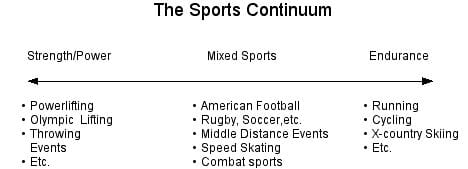
Lyle McDonald's Sports Continuum


Although, the mixed sports group also contains martial arts, I would be referring to team games in this article under that term. 


Power~Capacity 

So, Lyle presented a continuum of sports, training and adaptations based on the trade-off between Power~Capacity or Strength/Power~Endurance. Yes, we are dealing with complementarity one more time.
Power~Capacity trade-off


This concept of trade-off between Power~Capacity is also called critical power, or the average power one is able to produce for a certain time duration – the longer the duration, the lower the average power produced  and vice versa. And this has a lot to do with energy systems utilized and fatigue created. 

Taking Lyle’s graph (and his three group of sports), we can make the following:
Distribution of Power~Capacity in sports
 
It is important to mention that different parts of the Power~Capacity continuum are inter-related (both cross in terms of correlations, and longitudinal in term of transfer). This has couple of implications.

First, positive – working on one part of the curve may influence other parts of the curve, depending on their closeness. One concept based on this aspect is speed/power reserve. The concept of speed reserve states that by improving maximum (neuromuscular) power, one will be able to maintain sub-maximal power output for longer. Another concept is train slow to be fast. This concept is utilized in endurance sports where one accumulates great volume of low power/intensity workloads to improve average racing power output. These two concepts are especially presented in so called high-intensity sports, or sports of 2-8mins duration, like rowing, swimming and running, where you can attack sport performance from both direction – volume oriented and intensity oriented. In sprinting it has its own name:  from long-to-short and from short-to-long.

Second, negative – working on one part of the curve may negatively influence other part of it. For example, spending too much time developing endurance may negatively affect your speed and power, and vice versa, or decrease the effect of training. There are conflicting researches on this problem, especially in so called concurrent training programs where one is trying to improve both strength/power and endurance. Some papers report negative effects, while other actually report positive effects of concurrent training. In my opinion, it all comes to the level of the athlete and the workload utilized and their organization. On the flip side, there is a great fear of aerobic training these days, because it kills speed, or at least they say so. But is this really the case? Again it depends on the volumes of training and the level of the athlete (and his needs). It is true that extremely fast athletes have lousy endurance and extremely endurant athletes have lousy strength/power. 
But is this due their training accumulated over the years of development or because of the natural selection, where those athletes (with certain innate abilities) naturally gravitate toward those opposite activities? Nature~Nurture, Talent~Practice? Can we use this extremes to ditch the aerobic training for improving endurance and work capacity in non-extreme (mixed) sports and (lower and medium level) athletes? Will doing certain volume of aerobic training screw your mediocre speed? How extreme are you in both of your endurance and strength/speed and volumes of training of each? 
This goes along with the notion that “Playing basketball will make you tall”, or “Performing sprint training will make you look like a sprinter” (make sure to check Lyle’s article Pole Vault your way to a hot body and Sprinters vs. Marathoners)? Well, it is not going to, because taller players and faster athletes naturally gravitate (because of selection process) toward those sports. The point of this rant is that we need to take a lot of factors and context into consideration before making bold claims. Beware of this, because it is very frequent. Your beliefs and terminology (language) will affect your thought, your thoughts your decisions, and your decisions will affect your actions and training and this will affect your results and performance.  

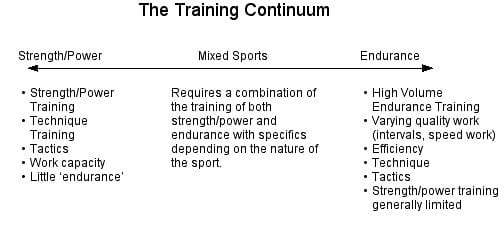
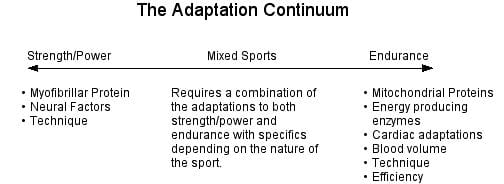
All this differences influence the training done and adaptations sought by mentioned three groups of sports. Lyle presented those two continuum in the following pictures:

Lyle McDonald's Training Continuum


Lyle McDonald's Adaptation Continuum


Stay tuned to Part 2 in which I will cover characteristics of mixed sports (team games).

Tuesday, May 10, 2011

Books, books, books....

Couple of new things. After the publishing of my Book Recommendations for 8WeeksOut, Joel published the legendary Fundamentals of Sports Training by L. Matveyev in scanned pdf e-book form for FREE! This is a book that started it all. Make sure to download it.


Speaking of books and periodization, another amazing product by Ultimate Athlete Concepts:

This e-book is a compilation of questions and answers from Prof. Verkhoshansky's forum and I must admit it is written and compiled very well. A lot of concepts were cleared up and it is a must read. Even the Preface is worth the money because it clears a lot of confusions and explains the evolution of The Block Training System by late Yuri Verkhoshansky. The second edition of Special Strength Training: A Practical Manual for Coaches is about to be published very soon too and I can't hardly wait for it.

In the next couple of days you can also expect the special edition of my soccer series in a form of e-book for 8WeeksOut website. I will provide the link once it is available.


Also, you can expect the interview with Carl Valle and Vern Gambetta, sharing their thoughts on some very interesting topics.

Make sure to also check new article series by Lyle McDonald on Heart Rate Variability

Well readers, this is going to be pretty interesting Spring in terms of information. Let's get to work!

Wednesday, May 4, 2011

Short news...

Just wanted to let you know that I am working on the special edition of 8-weeks soccer pre-season plan for Joel Jamieson's 8WeeksOut website in a form of printable e-book, that should be available in a week or two.

Joel also recently published my Recommended Reading list at 8WeeksOut. You can get the PDF by clicking on this link.

The soccer season is getting to the end in couple of weeks, and we are already working on the next season plan, taking into accounts our good and bad actions and decision we did in this one. I am identifying the things that need improvement and hopefully the next preparatory period is going to be even better than the last one, for the main reason of already knowing athletes and them knowing me and my approach. I am reflecting on things that I have done good and the things that I did poorly.

Personally, I am experimenting with  intermittent fasting (Leangains and Eat-Stop-Eat) and I am getting results. I am leaner than ever (184cm height and 92kg weight) and my lifts are increasing too. Some of the goals for the summer include:

* 89kg BW
* 180-200kg ATG back squat
* 220-250kg deadlift
* 130-140kg bench press
* 50kgx3 on pull-ups
* Dunk as Jordan


Hopefully, I am going to achieve those.... at least I am going to enjoy the process :).