Saturday, May 14, 2011

Problems of the periodization of training in mixed sports. Part 1

Introduction

This article was motivated by couple of things:

- Me trying to figure out the training plan for the next preparatory period for my soccer club, that starts in a month

- A short e-mail discussion with Lyle McDonald regarding the problems of the mixed sports

- A lack of information available on the internet, based on my Google search. A lot of people are confused by periodization models and their application to mixed sports and their own problems, specifics and context. Or as Lyle would say: “Square peg + round hole = bad things

The term mixed sports comes from Lyle McDonald. He recently published one article on this subject, hopefully also motivated by our short e-mail discussion. 
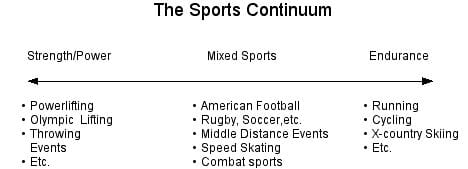
Lyle McDonald's Sports Continuum


Although, the mixed sports group also contains martial arts, I would be referring to team games in this article under that term. 


Power~Capacity 

So, Lyle presented a continuum of sports, training and adaptations based on the trade-off between Power~Capacity or Strength/Power~Endurance. Yes, we are dealing with complementarity one more time.
Power~Capacity trade-off


This concept of trade-off between Power~Capacity is also called critical power, or the average power one is able to produce for a certain time duration – the longer the duration, the lower the average power produced  and vice versa. And this has a lot to do with energy systems utilized and fatigue created. 

Taking Lyle’s graph (and his three group of sports), we can make the following:
Distribution of Power~Capacity in sports
 
It is important to mention that different parts of the Power~Capacity continuum are inter-related (both cross in terms of correlations, and longitudinal in term of transfer). This has couple of implications.

First, positive – working on one part of the curve may influence other parts of the curve, depending on their closeness. One concept based on this aspect is speed/power reserve. The concept of speed reserve states that by improving maximum (neuromuscular) power, one will be able to maintain sub-maximal power output for longer. Another concept is train slow to be fast. This concept is utilized in endurance sports where one accumulates great volume of low power/intensity workloads to improve average racing power output. These two concepts are especially presented in so called high-intensity sports, or sports of 2-8mins duration, like rowing, swimming and running, where you can attack sport performance from both direction – volume oriented and intensity oriented. In sprinting it has its own name:  from long-to-short and from short-to-long.

Second, negative – working on one part of the curve may negatively influence other part of it. For example, spending too much time developing endurance may negatively affect your speed and power, and vice versa, or decrease the effect of training. There are conflicting researches on this problem, especially in so called concurrent training programs where one is trying to improve both strength/power and endurance. Some papers report negative effects, while other actually report positive effects of concurrent training. In my opinion, it all comes to the level of the athlete and the workload utilized and their organization. On the flip side, there is a great fear of aerobic training these days, because it kills speed, or at least they say so. But is this really the case? Again it depends on the volumes of training and the level of the athlete (and his needs). It is true that extremely fast athletes have lousy endurance and extremely endurant athletes have lousy strength/power. 
But is this due their training accumulated over the years of development or because of the natural selection, where those athletes (with certain innate abilities) naturally gravitate toward those opposite activities? Nature~Nurture, Talent~Practice? Can we use this extremes to ditch the aerobic training for improving endurance and work capacity in non-extreme (mixed) sports and (lower and medium level) athletes? Will doing certain volume of aerobic training screw your mediocre speed? How extreme are you in both of your endurance and strength/speed and volumes of training of each? 
This goes along with the notion that “Playing basketball will make you tall”, or “Performing sprint training will make you look like a sprinter” (make sure to check Lyle’s article Pole Vault your way to a hot body and Sprinters vs. Marathoners)? Well, it is not going to, because taller players and faster athletes naturally gravitate (because of selection process) toward those sports. The point of this rant is that we need to take a lot of factors and context into consideration before making bold claims. Beware of this, because it is very frequent. Your beliefs and terminology (language) will affect your thought, your thoughts your decisions, and your decisions will affect your actions and training and this will affect your results and performance.  

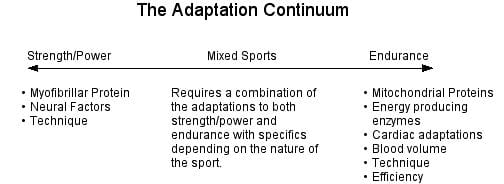
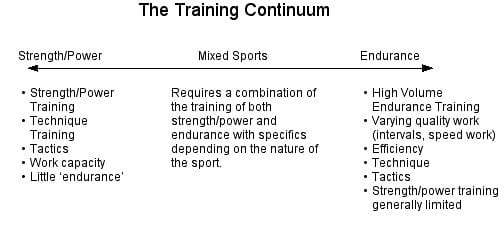
All this differences influence the training done and adaptations sought by mentioned three groups of sports. Lyle presented those two continuum in the following pictures:

Lyle McDonald's Training Continuum


Lyle McDonald's Adaptation Continuum


Stay tuned to Part 2 in which I will cover characteristics of mixed sports (team games).
Tuesday, May 10, 2011

Books, books, books....

Couple of new things. After the publishing of my Book Recommendations for 8WeeksOut, Joel published the legendary Fundamentals of Sports Training by L. Matveyev in scanned pdf e-book form for FREE! This is a book that started it all. Make sure to download it.


Speaking of books and periodization, another amazing product by Ultimate Athlete Concepts:

This e-book is a compilation of questions and answers from Prof. Verkhoshansky's forum and I must admit it is written and compiled very well. A lot of concepts were cleared up and it is a must read. Even the Preface is worth the money because it clears a lot of confusions and explains the evolution of The Block Training System by late Yuri Verkhoshansky. The second edition of Special Strength Training: A Practical Manual for Coaches is about to be published very soon too and I can't hardly wait for it.

In the next couple of days you can also expect the special edition of my soccer series in a form of e-book for 8WeeksOut website. I will provide the link once it is available.


Also, you can expect the interview with Carl Valle and Vern Gambetta, sharing their thoughts on some very interesting topics.

Make sure to also check new article series by Lyle McDonald on Heart Rate Variability

Well readers, this is going to be pretty interesting Spring in terms of information. Let's get to work!

Wednesday, May 4, 2011

Short news...

Just wanted to let you know that I am working on the special edition of 8-weeks soccer pre-season plan for Joel Jamieson's 8WeeksOut website in a form of printable e-book, that should be available in a week or two.

Joel also recently published my Recommended Reading list at 8WeeksOut. You can get the PDF by clicking on this link.

The soccer season is getting to the end in couple of weeks, and we are already working on the next season plan, taking into accounts our good and bad actions and decision we did in this one. I am identifying the things that need improvement and hopefully the next preparatory period is going to be even better than the last one, for the main reason of already knowing athletes and them knowing me and my approach. I am reflecting on things that I have done good and the things that I did poorly.

Personally, I am experimenting with  intermittent fasting (Leangains and Eat-Stop-Eat) and I am getting results. I am leaner than ever (184cm height and 92kg weight) and my lifts are increasing too. Some of the goals for the summer include:

* 89kg BW
* 180-200kg ATG back squat
* 220-250kg deadlift
* 130-140kg bench press
* 50kgx3 on pull-ups
* Dunk as Jordan


Hopefully, I am going to achieve those.... at least I am going to enjoy the process :).

Friday, April 15, 2011

Stop obsessing, start doing


“Anticipation is a killer.   It can lead to fear.  Fear that you won’t perform as expected on your heavy days.  Over time, this can lead many lifters to slowly be less and less motivated to come to the gym on those days.  And even when they do, they are so anxious that they have a worse workout than they could have had.”

“This should be a positive motivation, one that drives you toward attempts, the journey of lifting, not the possible outcomes of those attempts: makes or misses.”

“Yes, goal setting is great.  Writing up routines that are designed to help you to reach those goals is often a good idea.  But, we can’t lose sight of the bigger picture.  You only get better if you keep moving forward.  Even if you fail, you’ve moved forward, because you’ve attempted it (my friend Maria and I call this “Failing Forward”).”

“Stop obsessing, start doing”

First off I need to thank Lyle McDonald and Matt Perryman for bringing to my attention Nick Horton’s Iron Samurai website.

Nick Horton, the Iron Samurai
 
Secondly, I am amazed by the article from which I have stolen quotes at the beginning - The Death of Heavy Days: How To Do More Work with Less Obsession. It pretty much addresses the issues I am dealing myself, both professionally and personally.

We are obsessing with the goals. Fixating on goals and forgetting to enjoy the ride. This can lead to emotional burnout and injuries. 

Journey ~ Destination


Again, it is complementarity. We need both. The problem is that we keep emphasizing one part of this complementarity.

I trapped myself by obsessing myself with things, from reading certain book, to eating certain food and training, 
hitting certain percentages, hitting PRs, spending certain time reading/learning, doing certain number of sets, doing more reps, increasing weight, giving my best performance and the list goes on and on. Having high expectations is bad as having none. The truths is somewhere in the middle, in the shades of gray. If we have low expectations we will suck and give up, and if we have high expectations we will burn-out. We are forgetting to enjoy the ride by fixating (obsessing) on the goals.

As Anthony De Mello said (if I am not wrong): Life is the thing that happens while we are obsessed with other things.

All of these high expectations gave me migraine, and my neurologist said it hits migraine-like people. I wonder was I born that way or I was made that way, and can I change. Probably both. I am obsessed with details and purpose (goal).

This reminds me of the tip my chiropractor gave me when I injured my back couple of years ago. Imagine yourself driving in beautiful countryside. Instead of enjoying the ride and sigh-seeing while maintaining safe ride, you are speeding to get to your destination. Slow down, and enjoy the ride he said.

You still need to have expectations though. It is shown that athletes, for whom coaches show no expectations and thus demand less, also perform less and improve less. Again, shades of gray.

All this talk goes well with Fixed Mindset and Growth Mindset. Fixating on the goals and improvement might seem like Growth Mindset, but I think it is actually not. As Nick Horton said in the quote above: “This should be a positive motivation, one that drives you toward attempts, the journey of lifting, not the possible outcomes of those attempts: makes or misses.” This is true Growth Mindset. Enjoying the ride; enjoying the hard work; enjoy the failures.

I have made a lot of mistakes that have cost me emotional burnout and injuries, along with abusing pre-workout stimulants. I have put too much obsession into training. “I need to try PR today.”; “I need to give my best at the workout”; “I need to improve today”. This have led others thing to suffer among constant stagnation in training and actually missing my goals because of inconsistency due injuries or emotional burnout. Yes, you need to make sacrifices, but not that much so they impair you; so much that they impair your normal life as a human being.

Philosopher Seneca use to say that people get angry and disappointed because they have high expectations. When you go to work you expect no traffic delay. When you go to the post office you expect no waiting line. When you go out you expect to have good time and pick up some hot chick(s). When you go to the gym to do hard day you expect to hit those damn weights and hit PRs. We need to embrace the shitty workouts. Dan John wrote wonderful article on this. And he is right on the bat. We need to stop obsessing with goals, outcomes and start enjoying the ride, enjoying the attempts, enjoying shitty workouts, enjoying failures, because this is actually going to move us forward. Because, this will actually make us reach our goals. Because, this is the true Growth Mindset.

But is all this Positive Thinking? Is this Law of Attraction? New Age Zen crap? Nope. I am being Optimistic Realist. Problems will always be there, the question is how we are going to react to them – reactively or proactively. Having high expectation is a problem too. Burn-out is real. Injuries are real. You cannot force adaptation no matter how much positive thinking you have. You can push it a little bit, but you cannot force it. No matter how much you believe in The Secret. No matter how much your coach yells at you. And actually, this approach is being realistic (and if you are having fun along the way it is being optimistic realistic). Sometimes you are tired from all night sex (haven’t happened to me lately though). Sometimes you are time churched. Sometimes your soccer players drained your energy and you feel like shit. Sometimes it is the stupid public transportation. Life happens. 


The point being taken here is that we are proactively changing our mindset to be more reactive to our biology and immediate training responses. This is the whole basis of auto-regulatory training. Mike Tuchscherer bases his Reactive Training System on RPEs. Sometimes 235kg will feel like 8. Sometimes 200 will feel like 8. You are not going into the gym to hit certain weight, but to hit certain attempt (expressed in terms of perceived exhaustion). Even percent based programs can utilize similar auto-regulation. Take Wendler’s 5/3/1 program for example. Instead of doing a top set with 85% 1RM for 5(+), you can attempt to see how much reps you can do with that weight. No expectations. Just attempt to do your best with the certain percentage. You did 2? Who cares, as long as you have enjoyed trying. This will keep you consistent, injury free and without emotional burn-out. Consistency over long-term doing the basics leads to improvement, leads to expertise.  

So, stop obsessing and just give it a try. See how it goes. Just do the warm-up and see how it goes. Lower your expectations.

Thursday, April 14, 2011

Random thoughts and links


For anyone interested into expert (elite athletes) development, I highly suggest checking out the following articles (this is a series of articles, but only two parts at the moment):


This series brings some more oil into the fire of early specialization vs. early diversification viewpoints and tries to explain researched phenomena in CGS (centimeter, gram, second) sports utilizing motivational/psychological and talent/physiological point of view. Make sure to read the comment sections too.  Yes, you have guessed correctly – it is complementarity between the two.

I have also come across to Vern Gambetta’s video this morning about game speed.

While I am waiting for The Switch and Made to Stick books, I accidentally found great short series of videos on YouTube. 
The first video is a summary of the book Drive by Daniel Pink. Pink is doing a fine job explaining why extrinsic motivation is not enough, and why we need to address intrinsic motivation. 


It is not enough to manipulate athletes with carrots and sticks like Pavlov did with his damn dogs and B.F. Skinner did with his pigeons (I am very thankful for their mechanical point of view [sarcastic] ), but is also important to manipulate the environment that brings up (emerge?) certain behavior via instric motivation, and autonomy, complexity and purpose of the task. 


This goes pretty well with complex system theory, and the importance of expanding our interest from the athletes themselves (their traits, characteristics, etc) to the environment that brought them that way, both in longer-term (LTAD) and short term (team culture). 

There is a fine video by Kristoffer Henriksen on importance of researching environment that brought up certain the experts, not just their traits, eye colors, genes or whatever. It is also important to develop certain team culture, or team spirit that will allow expert development while providing autonomy, complexity and purpose in and over the task with purposeful (deliberate) practice. As my head coach use to say, a lot of coaches and athlete are training with the form on mind. They all fulfill the ’form’ of the training. But what really makes a difference is the ’substance’. Details. And the devil is in details. What is important from coaching standpoint is to develop a certain team ambient that allows (affords) purposeful practice and Growth Mindset in the athletes.

Another video worth checking (btw, check all the videos from RSAnimate) is on communication by Steven Pinker. Maybe you will find something interesting in it applicable to sport situations. 


The next video by Jeremy Rifkin, along with work by Richard Dawkins  (Selfish Gene) and work by Robert Sapolsky (Why Zebras Don't Get Ulcers) made me think are the humans really competitive in their nature or are we (culture) making them that way. This goes again into the importance of building up team culture that allows empathy within the team. 


Well, as you might have seen, I am more into psychology and problems of coaching lately while I put a hold on the ‘periodization’ and what have you. The point behind this is that I am more interested into ‘what is making the difference’ , and in my opinion it is not new supplement, new gadget, complex planning and programming, but rather the development of  the team spirit and mindset that allows the purposeful practice (and stable-consistent performance) for working on the basics and important fundamentals over and over again (while the others hit it the on occasion) and fine-tuning the details, day in and day out.  

Anyway, I am planning to write one ‘addendum’ to soccer series and sport form, with the special reference to in-season training. Hopefully, I will find time and writing mojo for it.

Till next time... stop for a minute and smile :)

Tuesday, March 22, 2011

Short update

It has been a while since I've updated this blog. To be honest I have been working and training myself and my writing mojo has left me one more time. I was thinking about writing on in-season planning, basically sharing my ideas, but I somehow I don't feel like writing. Maybe after the season is over I could sum up some  of my thoughts and the things we did here in FC RAD.

As for me, I am back to Brazilian Jiu-Jitsu (BJJ) and Boxing. I have found some great thoughts about BJJ training by Matt Thornton in his blog - Notes on Drilling. I am also pretty heavy (97kg) and I am thinking about reducing my body mass a little (to 91-93kg). I am experimenting with Intermittent fasting, not following it to the word though, but still trying to find a dietary approach that suits me and my my training regime. Need to cut strength work too (number of sets), because it is making me too damn tired with BJJ and boxing (and fasting/diet).

The season started pretty good here. From four matches we won two and did two draws. The last match we played was against FC Partizan, the National Champion and we did great. In the first half we were leading by 2:1 and in the second half they scored, thus we finished 2:2. Even if we played at home, the referring was pure horror. Even the fans of the FC Partizan were shocked by referee and his decisions (in favor of Partizan). But that is the part of the game, right? Anyway, here is the short preview of the mentioned game:


One thing I would also love to mention is that Joel Jamieson updated his website to 2.0 version :) Make sure to check it out - http://www.8weeksout.com/

Another thing that is in my mind at the moment is the importance of sport psychology. The more I am experience as a coach, the more I see the importance of it. You can have all the knowledge in the world, but if you suck at this, you will suck. Sad but true. I am wondering how to 'pull' the most out of my athletes in terms of performance and effort at the training sessions and games. It is not enough to manipulate with awards/punishments (this is behavioristic view-point and is mechanistic in my opinion). The environment (team culture) needs to be considered too, along with intrinsic motivation. This reminds me of the discussion by Robert Sapolsky on Ethology.We need to consider the environment too.

Anyway, this (sport psychology) is the area that I am most interested lately, giving some rest to biomechanics, physiology and motor learning.  I am currently reading a book by my neighbor from Pula, Croatia who is psychiatrist on "How to become (and stay) successful coach" and I am also thinking about getting these books:


There is a good review of the Switch book by Matt Perryman at Amped Training. And that's it for now. Hopefully I will find more time (and motivation) to keep this blog up-to-date.

Until then viva la vida :)


Sunday, February 20, 2011

Back to business...

I was quite busy lately and actually on training camp on Cyprus with FC RAD  (you can check some of the pics here), thus I was not able to post much (or at all). I have actually met great Roberto Sassi in Larnaca when we played against FC Dynamo from Moscow. He was tracking his players HRs using Polar system. Unfortunately, we were unable to chat for long although I think that would be time well spent.


I am in the process of reading 800+ pages of printed out research and watching excellent video lectures on Performance in Sports involving Intense Exercise, some of which are based on the articles I am just reading. Make sure to watch them!

We are entering in-season from tomorrow, since the first game is on Saturday. Expect some posts on in-season training and some thoughts on RSA along with general gibberish.

In the mean time I highly suggest checking David Tenney's article on soccer at 8WeeksOut.com

As for me, I am back to lifting although I have some small SI joint tweaks now and them which is the daemon that follows me all the time. I am using some of Lyle McDonald advices on this and I suggest taking a look at the forum thread and YouTube videos.  I also plan going back to martial arts (BJJ and boxing), but we will see with the time constraints.

And that's all with this "update". Going to lift